


From Forgotten Fields to Flying History

Updated: Feb 20
Rescuing Warbirds from the Rantoul, Kansas Aircraft Boneyard
For decades, the quiet fields outside Rantoul, Kansas held the remains of some of America’s most important military aircraft. To most passersby, they looked like scrap—sun-bleached aluminum, missing parts, weeds growing through landing gear. But to those who understand aviation history, these aircraft were never junk. They were veterans waiting for someone to listen.
This page documents three critical moments in the preservation of those aircraft: the recovery of a World War II C-47 Skytrain, a hands-on inspection and tour that revealed its true condition and story, and the rescue of a combat-proven A-26 Invader that would eventually fly again as Lady Liberty.
These stories all trace back to one place and one man.

The Rantoul Aircraft Boneyard: A Place Time Forgot
The Rantoul site was not an official salvage yard in the modern sense. It was farmland with a long, complicated aviation history—an airstrip used for agricultural aviation, aerial firefighting, and long-term aircraft storage. Over time, the field became known informally as an “airplane boneyard,” though many of the aircraft parked there were structurally intact and historically significant.
Large transports, fire tankers, and war surplus aircraft came and went. Some were parted out. Others simply waited.
At the center of it all was Bill Dempsay (also documented in records as Dempsey), a Kansas aviation operator whose work bridged multiple eras of post-war American flying—from crop dusting to aerial firefighting to the uneasy limbo that surplus military aircraft often find themselves in after their service ends.
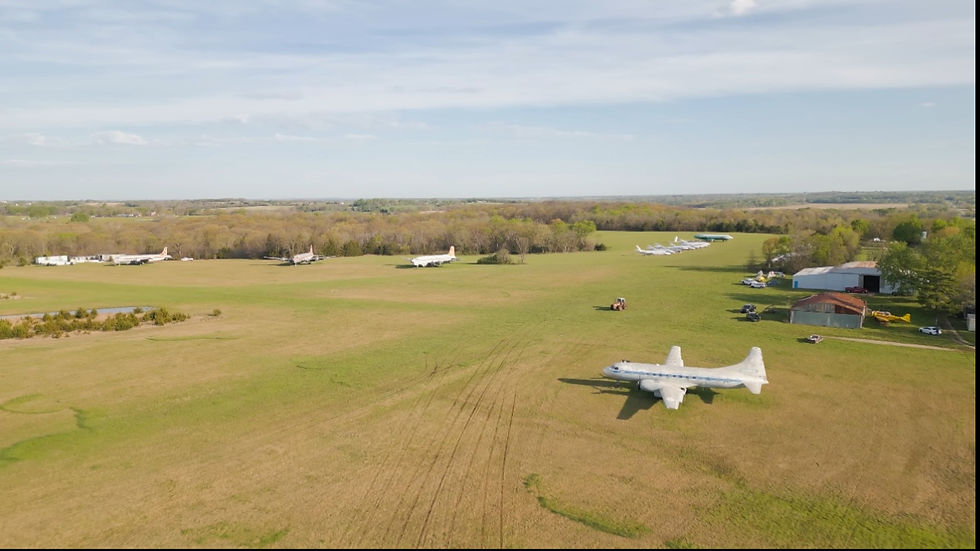
Video 1: Moving the C-47 — From Rantoul to Ottawa, Kansas
The recovery of the 1944 Douglas C-47 Skytrain (USAAF serial 44-77272) was not a restoration milestone it was a rescue.
This aircraft had been sitting for years at the Rantoul site, exposed to the elements but largely intact. Moving it was a logistical challenge involving planning, patience, and respect for what the airplane represented. Every step mattered, because once aircraft like this are lost, they are rarely replaced.
The move from Rantoul to Ottawa Municipal Airport (KOWI) marked the first real step in returning this aircraft to relevance. It was no longer just an artifact in a field—it was once again an airplane with a future.
This was not about speed or spectacle. It was about doing it right.

Inside the C-47: Tour & Inspection with Jim Reeder
Stepping inside the C-47 tells a deeper story than any logbook ever could.
During this detailed walk-through and inspection, Jim Reeder shares firsthand insight into the aircraft’s structure, condition, and long road ahead. The inspection reveals both expected wear and remarkable survivability—testament to the C-47’s legendary design and wartime build standards.


Bill Dempsay’s Role in the Aircraft’s Story
Bill Dempsay was not a museum curator. He was an operator.
Records and firsthand accounts link him to D & D Aero, an operation that began with agricultural spraying in Kansas and later expanded into aerial firefighting. Aircraft under his ownership or control including the C-47 and multiple large transports were working airplanes long after World War II ended.


The C-47 at Rantoul was not parked as a display piece. It was part of a working ecosystem of surplus aircraft that were repurposed, modified, flown hard, and eventually sidelined when economics or regulations caught up with them.

This context matters.
It explains why the aircraft survived at all. Dempsay saw value where others saw obsolescence. While not every decision preserved history perfectly, the fact that this C-47 still exists—largely complete—speaks for itself.
Without that chapter, there would be nothing left to restore today. THANK YOU BILL DEMPSAY!
Video 2: The full tour and initial inspection of the C-47 and the mystery of the United Nations stencils on the wings.
The A-26 Tanker 105 now known as Lady Liberty owned by the CAF
The Rantoul field did not just hold transports. It also held combat aircraft with extraordinary pasts.
One of them was a Douglas A-26 Invader, later known as Lady Liberty. After military service and post-war government use, the aircraft entered civilian hands and was converted into a fire bomber, operating as Tanker 105.

Historical records confirm that the aircraft passed through Bill Dempsay’s ownership in Kansas during its firefighting years. Like many surplus warbirds, it lived a second life doing dangerous, essential work long before anyone considered it a museum piece. Bill Dempsay sold the A-26 eventually because it wasn't being flown often.
That aircraft would later be seized by the DEA, auctioned, and eventually restored by the Commemorative Air Force, where it flies today as a living example of preservation done right. In a recent accident in 2025 the A-26 has been grounded due to a nose gear collapse but is slated to make a full repair and recovery and fly again.
Its survival, like the C-47’s, is not accidental. Bill Dempsay played a major role in continuing it's life.
You can read more about the A-26 here.
Video 3: The A-26 Invader — From Fire Bomber to Lady Liberty
Why These Stories Matter
Aircraft preservation is rarely clean or romantic. It happens in fields, hangars, scrapyards, and back lots. It involves imperfect people, changing regulations, and hard economic realities.
But history survives because someone, somewhere, didn’t give up on it.
The Rantoul boneyard was not the end of the line it was a holding pattern. Today, these aircraft are being documented, restored, and returned to relevance, not just as static displays, but also as teaching tools and flying memorials.
This Channel is about honoring that process honestly, accurately, and without rewriting the past.
More to come. Subscribe today.

Please reach out to us if you would like to have us document your aircraft restoration, or have any suggestions for future videos. Thanks. Nathan.


Comments